
Many of my friends and readers have a hard time understanding why we Catholics have such strong devotion to Jesus’ mother, Mary.
Since St. Peter 3:15 says that we should “always be ready to give a logical defense to anyone who asks you to account for the hope that is in you,” I decided to write a series of posts about why Our Lady is so important to us.
The first defense I shall give is for Mary’s Queenship.

The notion of Mary as queen is a stumbling block for many people. Christ is Our King; why do we need a queen? We can go straight to Jesus, the Mediator between us and God the Father; we don’t need anyone to mediate between us and Jesus!
So why do Catholics talk about going ‘to Jesus through Mary’?

Edward Sri, in his article Is Mary’s Queenship Biblical? explains how in the Old Testament, the mother of the king was always the queen.
“(I)t is precisely from a Biblical perspective that Mary’s queenship makes perfect sense. For in ancient Israel, it was the king’s mother who reigned as queen, not the king’s wife.”
He demonstrates how this was for practical reasons. “Most kings in this period had large harems. King Solomon, for example, had 700 wives and 300 concubines (1 Kings 11:3). It would have been impossible to bestow the queenship on 1,000 women! Yet, since each king had only one mother, the queenship was typically given to her.”

The author writes that “the queen mother had a real share in her son’s reign, helping in his mission to shepherd the people (Jer. 13:18-20) and serving as a trusted counselor (see Proverbs 31). But most of all, the queen mother served as an advocate for the people, hearing their petitions and presenting them to the king.”
When Bathsheba tells her son Solomon that she wishes to ask a favor of him, his response is ‘Make your request, my mother, for I will not refuse you’ (1 Kings 2:20).”
At the marriage feast at Cana, Jesus listened to His mother’s petition even before His public ministry had begun, as Saint Alphonsus de Ligouri points out in his wonderful book, The Glories of Mary. Her compassion for the wedding hosts who had run out of wine was so great, that she appealed to her Son for help.

He told her that His time had not yet come (John 2:4) yet, despite that, He honored His mother’s request. Such is the power of Mary to intercede on our behalf with her Son!
These Biblical insights help us understand why Mary is the Queen Mother in her Son’s Kingdom. I highly recommend reading Edward Sri’s article, which cites other Scriptural references to support Catholic belief in Mary as Our Queen.
Since He is King of the whole world, she is Queen of the whole world. Therefore, all of us who serve God should also serve Mary, says St. Bernadine of Sienna. Note that we shouldn’t serve Mary instead of God. But, as Our Queen, Mary does merit our service.

RELUCTANCE TO APPROACH OUR KING & JUDGE
St. Alphonsus de Ligouri reminds us that we can lose God’s friendship through sin. “But your iniquities have separated you from your God (Isaiah 59:2).”
Yet in the words of St. Bernard, he tells us to “Take courage, oh, sinner, who has lost God. Thy Lord Himself hath given thee a mediator, even His Son Jesus Christ Who can obtain for thee whatever thou desirest.” Without question, we can go straight to Jesus when we have offended Him.
But what about those times when we are too ashamed to present ourselves before Him “Who was crucified and died for us men and our salvation,” as the Creed declares? Well aware that “Christ will come again in glory, to judge the living and the dead,” we sometimes cringe at the thought of approaching Our Fearsome Judge.
Here St. Bernard says, “if ever you fear to have recourse to Jesus Christ because His divine majesty alarms you” – for He is still God, even though He became man – “if you ever wish for another advocate with this mediator, invoke Mary, for she will intercede for you with the Son, Who will surely graciously listen to her, and the Son will intercede with the Father, who can refuse nothing to this Son.”
The saint concludes with a delightful image of Mary as “the ladder of sinners, by which they ascend anew to the height of divine grace.”
APPROACHING THE COMPASSIONATE QUEEN OF MERCY
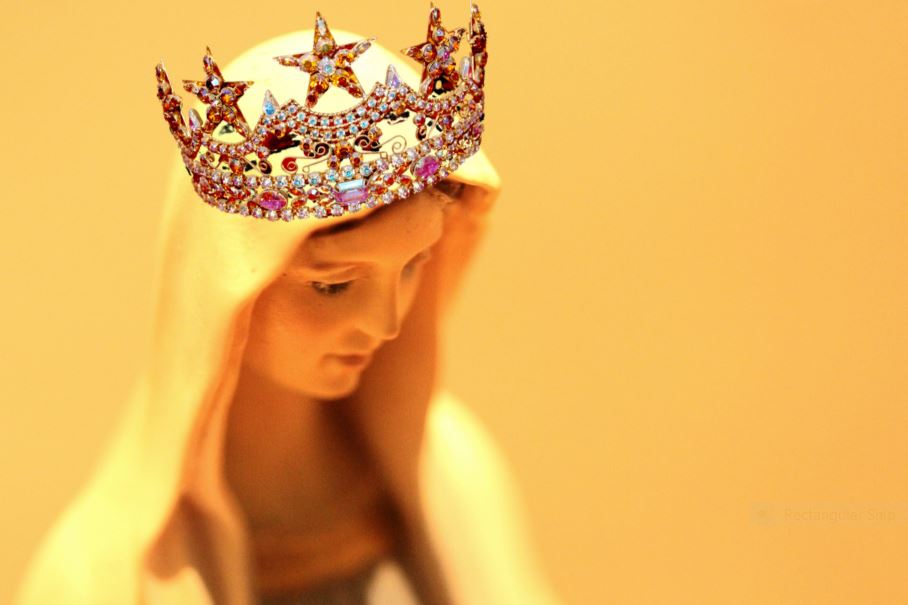
Mary wields enormous power in her role as queen, and she happily exercises it for our good, if we acknowledge her and show her allegiance.
We call her the Queen of Mercy because she is not a severe empress, but a compassionate ruler, who has for her object the good of her subjects. She is not “queen of justice, intent upon the punishment of the guilty, but queen of mercy, solely intent upon compassion and pardon for sinners. Accordingly, the Church requires us explicitly to call her queen of mercy.”
St. Alphonsus tells us that Mary was compared to the moon by St. Bonaventure, because, as the moon is placed between the heaven and earth, “so she continually interposes between God and sinners, that she may appease the Lord towards them, and enlighten them on their return to God.”
FROM GOATS TO SHEEP
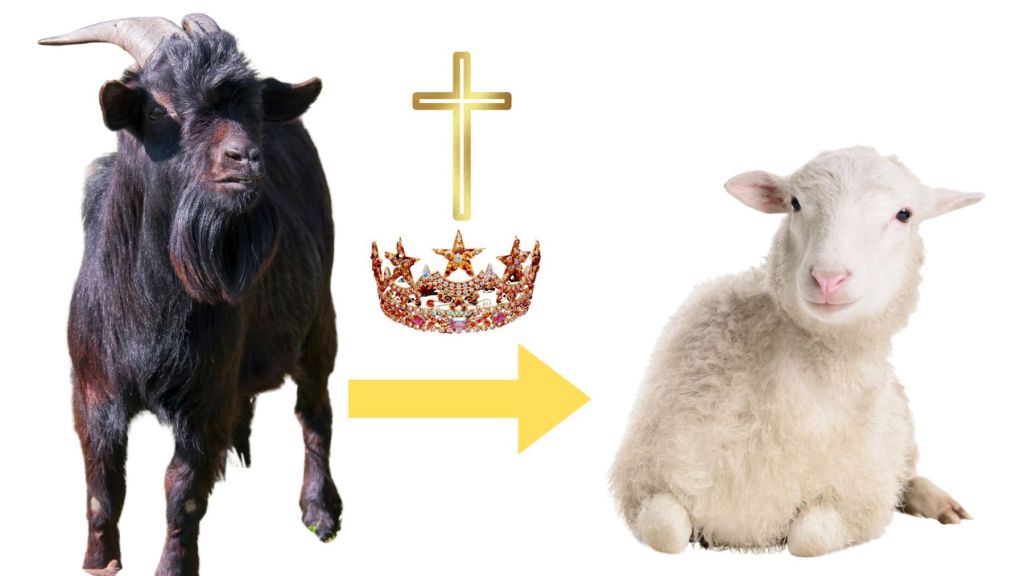
Mary’s most important office is that “of lifting the souls fallen from divine grace, and reconciling them to God.” St. Alphonsus says that William of Paris speaks of Mary’s intercession turning sinners – those wicked goats who will be separated from the elect of God – into sheep, and placing them on the right hand of the Lord, instead of abandoning them to the left, where they “have merited to be banished.”
I hope the above has helped you begin to see the importance of Mary for Catholics.
Next time I will delve into why we consider Mary the Holy Mother of God.
RESOURCES
THE GLORIES OF MARY By Saint Alphonsus de Liguori
IS MARY’S QUEENSHIP BIBLICAL?
Isaiah 52: https://biblehub.com/niv/isaiah/59.htm
 Hilary Walker Books